



Before optimizing the product page, checkout, or funnel experience, ask yourself this: are paid visitors actually engaging like potential buyers, or are they only clicking?
According to Triple Whale’s analysis of ad data from over 33,000 brands, brands with chronically low conversion rates often over-focus on click metrics such as CTR and CPC, while actual conversions and ROAS remain weak. The issue is not simply that the website fails to convert. In many cases, the traffic itself lacks enough purchase intent to convert.
That is why traffic intent assessment should come before CRO execution. In this article, we look at how to assess traffic intent using engagement rate, product exploration depth, site search behavior, add-to-cart rate, and channel-level intent, and how to tell whether the real problem is traffic quality or user experience.
TMO’s Conversion Optimization Services help D2C brands diagnose whether conversion problems come from traffic quality, user experience friction, or both, then prioritize the fixes most likely to improve revenue from existing traffic.
Are Your eCommerce Campaigns Driving Qualified Traffic?
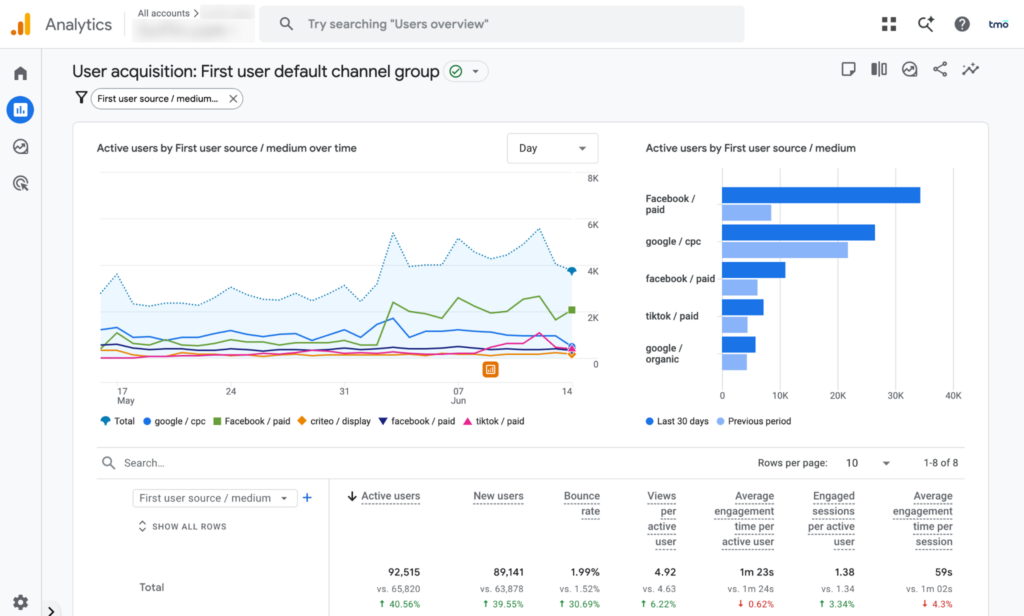
Conversion rate alone can be misleading. A low conversion rate may point to a weak product page, poor mobile UX, unclear pricing, or checkout friction. But it may also point to the wrong traffic: visitors who clicked an ad but never had enough intent to browse, compare, add to cart, or buy.
Traffic source benchmarks make the issue clearer. Email, branded search, organic search, paid social, and display advertising do not carry the same level of purchase intent. The same product page can perform very differently depending on whether the visitor arrived through an active search, a remarketing email, or a passive social feed impression.
Traffic intent assessment looks at upstream behavioral signals before the checkout stage, including:
- Whether users stay long enough to engage
- Whether they explore product or category pages
- Whether they use site search
- Whether they add products to cart
- Whether certain channels consistently show weaker intent than others
The goal is to make sure conversion optimization work is applied in the right place. If users are engaged but not converting, the site experience needs deeper review. If users barely engage at all, the first problem may be traffic quality, ad targeting, or message mismatch.
5 Purchase Intent Signals
1. Engagement Rate
Engagement rate is one of the quickest ways to spot whether traffic is behaving like potential buyers or passive clickers.
In GA4, an engaged session is a session that lasts more than 10 seconds, includes at least two pageviews, or triggers a key event. On its own, this does not prove purchase intent. But when paired with other behavioral metrics, it becomes a useful early warning tool.
Metrics worth checking together include:
- Engagement rate
- Views per active user
- Average session duration
- Returning user rate
If a paid channel has consistently low engagement, short sessions, few pageviews, and almost no returning users, the issue is unlikely to be checkout design. More often, it points to poor traffic quality, weak message-to-page alignment, or an audience that is not ready to buy.
The exact benchmark will vary by brand, category, and traffic source. The more useful approach is to compare channels against your own baseline. If paid social engagement is consistently far below organic search or email traffic, that gap deserves investigation before deeper CRO work begins.
2. Product Exploration Depth
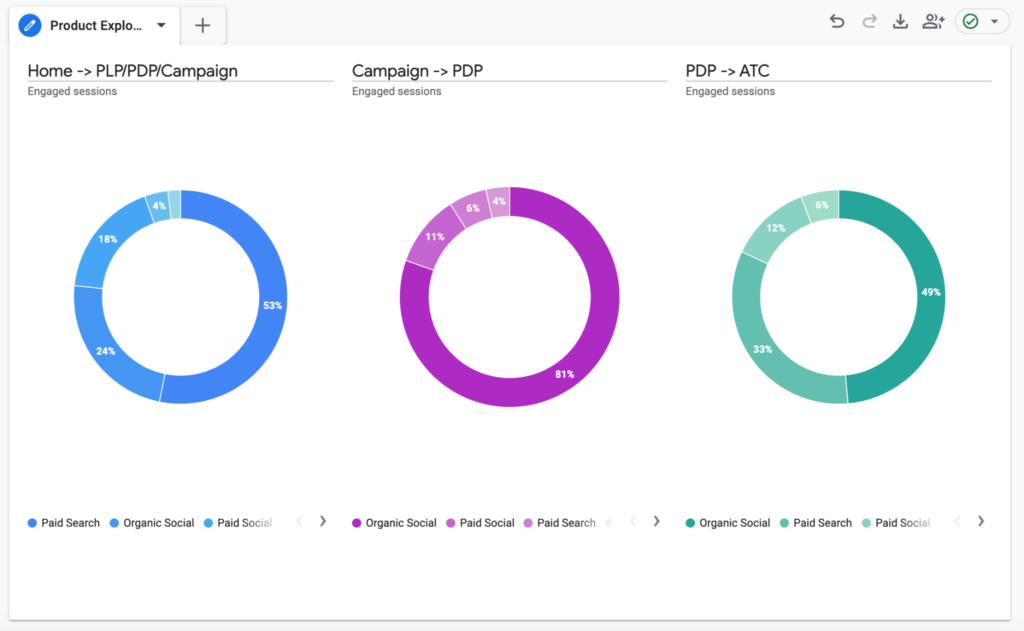
Product exploration depth shows whether visitors are moving from initial interest into active evaluation. For eCommerce brands, this usually means moving from the landing page into product listing pages, product detail pages, comparison content, or multiple category pages. Visitors with real purchase consideration tend to explore product information before making a decision. Visitors with weak intent often stop after one page. Metrics worth checking include:
- Product detail page views
- Product listing page views
- Views per session
- Category navigation clicks
- Product comparison or filter usage
If most paid sessions involve only a landing page view and no product exploration, the funnel is breaking before the product experience has a chance to convert. That usually points to weak ad-to-page alignment, low purchase intent, or a landing page that does not give users a clear reason to continue.
For high-consideration products, this signal is especially important. Users may not add to cart immediately, but they should still show signs of evaluation: browsing alternatives, checking specifications, comparing models, or returning to the same product page across sessions.
3. Site Search Behavior
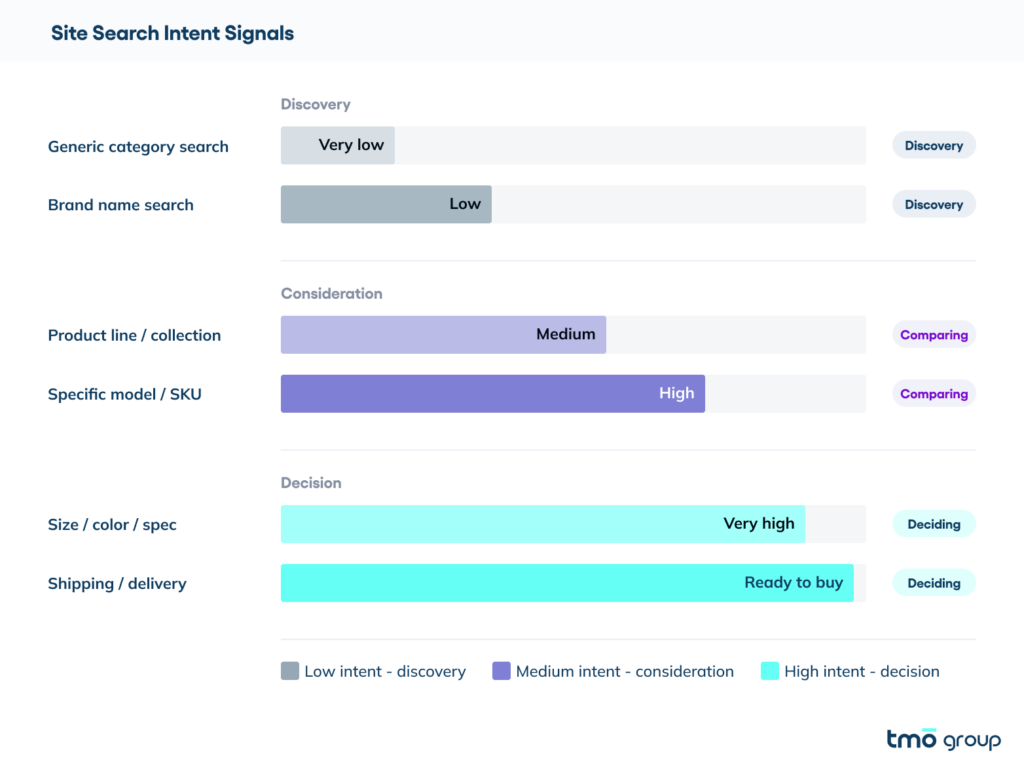
A user who searches is no longer just scrolling through the page presented to them. They are trying to find something specific: a product, size, color, technical specification, shipping information, or compatibility detail. Search behavior can reveal different levels of intent:
- Specific product model or SKU searches: Very high intent. The user already knows what they want and is checking availability or details.
- Size, color, material, or specification searches: Strong evaluation intent. The user is narrowing the decision.
- Shipping, return, or delivery searches: Late-stage intent. The user is checking final purchase conditions.
- Broad category or brand searches: Early-stage intent. The user is still exploring.
Low search usage can mean two different things. In some cases, visitors are not engaged enough to search at all. In others, the search bar may be hard to find, poorly designed, or not useful enough to support product discovery.
For CRO analysis, the most useful site search data is not only how often people search. It is what they search for, what results they receive, and whether those searches lead to product views, add-to-cart actions, or exits.
4. Add-to-Cart Rate
Add-to-cart rate is one of the strongest early indicators of purchase intent because it captures the moment a visitor moves from browsing to active consideration.
A low add-to-cart rate does not automatically mean the checkout is broken. If users are not adding products to cart in the first place, the issue is usually earlier in the journey: traffic relevance, landing page alignment, product-page clarity, pricing perception, or missing trust signals:
- Add-to-cart rate by traffic source
- Add-to-cart rate by landing page
- Add-to-cart rate by device
- Product views to add-to-cart
- Add-to-cart to checkout progression
If paid traffic has a very low add-to-cart rate while organic search, email, or returning users perform normally, the problem is likely not the website as a whole. It may point to weak audience targeting, low-intent traffic, or ad creatives that set expectations the product page does not satisfy.
If add-to-cart rate is healthy but checkout completion is weak, the diagnosis changes. At that point, the issue is more likely to sit in cart design, shipping clarity, payment options, checkout usability, or final trust barriers.
5. Channel-Level Intent
A user searching for your brand or a specific product is already expressing demand. A user clicking from a social feed may only be responding to creative, curiosity, or a momentary impulse. Both can be valuable, but they should not be evaluated with the same conversion expectations:
| Traffic Channel | Intent Level | Characteristics |
|---|---|---|
| Google branded search | Very high | Active, high-intent lookup; typically the highest-converting channel |
| Google non-branded search | High | Clear demand signal; user is actively comparing options |
| Display retargeting | High | The user has already visited the site or interacted with the brand and is being brought back |
| Organic search | Medium to high | Depends on keyword intent; informational content skews lower |
| Email / EDM | Medium to high | Existing brand awareness; re-engagement or promotional context |
| Meta ads | Low to medium | Passive exposure; user is in discovery mode, intent needs nurturing |
| TikTok ads | Low | Entertainment-first environment; impulse clicks, weak purchase intent |
| Display prospecting / awareness | Very low | Brand awareness only; rarely drives direct conversion |
This does not mean paid social traffic is bad. It means it needs to be judged correctly.
If social traffic brings strong engagement, product exploration, and add-to-cart activity, then CRO work can help improve the path to purchase. If it brings high clicks but weak engagement and almost no product interaction, the first problem is likely traffic quality or message-to-page mismatch.
Channel-level intent helps prevent one common CRO mistake: blaming the website for traffic that was never likely to buy in the first place.
How to Tell Whether the Problem Is Traffic or Experience
Once you have reviewed the intent signals, the next step is to separate traffic quality problems from website experience problems. This requires looking at two dimensions together:
- Traffic intent: Are visitors engaging, exploring products, searching, returning, or adding items to cart?
- Conversion performance: Are those engaged visitors completing the next step, such as adding to cart, starting checkout, or purchasing?
The combination usually points to one of four scenarios:
| High Conversion Rate | Low Conversion Rate | |
|---|---|---|
| High Traffic Intent | Healthy State: Focus on scaling traffic growth | The optimal CRO intervention scenario |
| Low Traffic Intent | Occasional conversions, not sustainable | Fix Traffic Quality First: Postpone UX overhauls. |
The most valuable CRO scenario is high traffic intent with low conversion. It means potential buyers are reaching the site, but something in the experience is blocking the purchase path.
That could include unclear product information, weak trust signals, poor mobile UX, limited payment options, checkout friction, or a mismatch between what the ad promised and what the landing page delivers.
Low intent with low conversion is different. If users are barely engaging, not viewing products, not searching, and not adding to cart, a checkout redesign will not fix the problem. In that case, the first priority should be traffic quality: targeting, creative, channel mix, offer, and message-to-page alignment.
| Observed Signal | More Likely a Traffic Quality Issue | More Likely a UX Experience Issue |
| Overall engagement rate below 40% | ✓ | |
| Paid channel engagement significantly below organic | ✓ | |
| Very low share of product page visits | ✓ | |
| On-site search usage near zero | ✓ | |
| Add-to-cart rate below 1% | ✓ | |
| Normal engagement rate but low add-to-cart rate | ✓ | |
| Normal add-to-cart rate but low checkout completion | ✓ | |
| Mobile conversion significantly below desktop | ✓ | |
| Historical data shows conversion was previously higher | ✓ | |
| Search visitors convert far above paid ad visitors | ✓ |
Apply for TMO's CRO Pilot Program
With customer acquisition costs having risen more than 220% over the past eight years for DTC brands, extracting more conversion value from existing traffic has become one of the highest-leverage decisions a brand team can make.
But there's a prerequisite that's easy to miss: not all traffic is worth optimizing, and not all conversion problems can be solved by improving the website.
Identifying which situation you're in is the core work of Phase 1 of TMO's CRO Program. We help brands answer one question before committing to a full CRO engagement: is the problem in the traffic, or in the experience?

Frequently Asked Questions (FAQ)
High traffic but low conversions typically stems from either a lack of genuine purchase intent in your traffic or user experience friction on your site. If your visitors come from paid channels with low engagement and near-zero add-to-cart rates, the issue lies in your audience targeting rather than the website itself.
E-commerce engagement rates typically range between 40% and 90% depending on your site type. Rather than chasing a single industry average, you should monitor variances between channels; for instance, a paid channel underperforming organic search by 15% or more indicates a clear traffic quality issue.
On-site search is an explicit expression of user demand, carrying much stronger intent than passive browsing. Users searching for precise SKUs or shipping terms are already at the doorstep of a purchase, whereas exceptionally low search usage usually means visitors are not in a decision-making mindset yet.
This is the ideal scenario for a CRO intervention because motivated buyers are arriving but encountering friction on your site. You should immediately audit your product page trust signals, value proposition clarity, and mobile checkout fluidity, as A/B testing in this environment drives the most immediate revenue gains.