



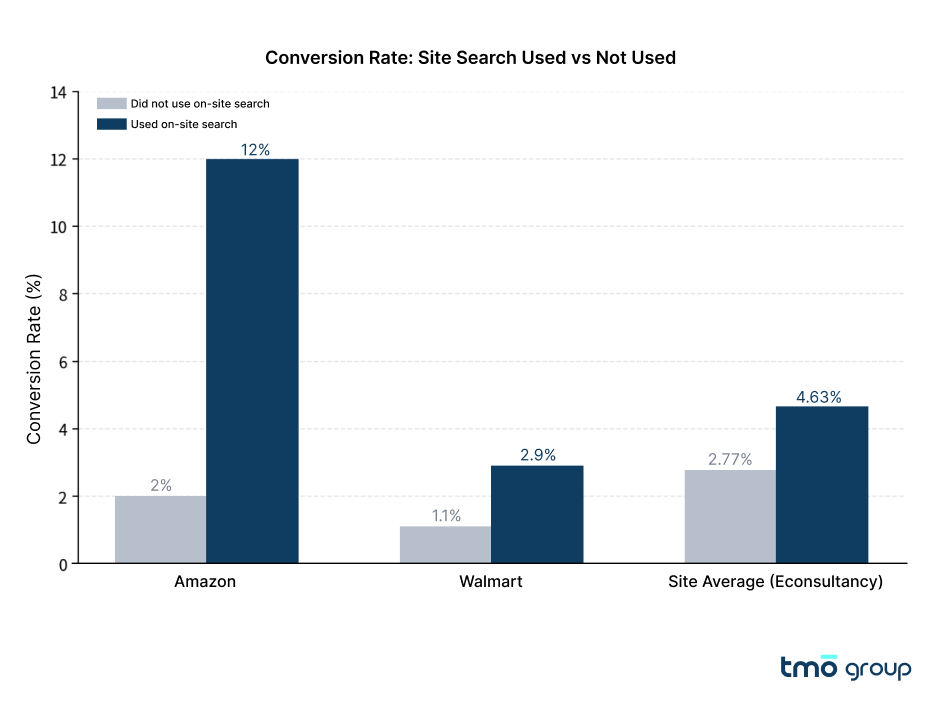
Industry benchmarks also frequently show site search users converting at 2 to 4 times the rate of non-search visitors. This partly reflects their clearer purchase intent, but it also means weak search can waste some of the most conversion-ready traffic on your store.
For mature D2C and cross-border brands, the problem usually extends beyond the search bar. Zero-result searches, limited synonym and natural-language support, weak mobile search, missing localized product attributes, and incomplete search analytics can all disrupt product discovery.
The potential impact from optimizing these issues can be substantial. In an Algolia customer case study, Lacoste reported a 37% increase in overall conversion rate after improving search speed, personalized ranking, and market-specific merchandising across its regional sites.
This article examines seven site search blind spots, the metrics that reveal them, and how to prioritize search optimization opportunities that can improve conversion rate, average order value, and product-data quality.
KEY TAKEAWAYS
- Site search users often convert at 2–4x the rate of non-search visitors.
- Zero-result queries, weak ranking, mobile friction, and missing localized attributes can block high-intent shoppers.
- AI-powered semantic search can understand typos, synonyms, and conversational buying intent instead of just exact keywords.
- Magento brands can implement AI search through Adobe Commerce Live Search, Algolia, or a custom architecture, depending on catalog and integration complexity.
TMO works with global brands to improve eCommerce conversion and implement AI-driven solutions such as smart site search.
Search Drives Both Conversion and Order Value
On-site search should be measured as a distinct conversion path, not simply checked as a website feature. Search users often arrive with a specific product, category, or attribute in mind, so the quality of query interpretation, product ranking, filters, and search-result design directly affects whether that demand reaches a product page and converts.
A successful search journey may also increase basket depth. According to Google Cloud research, more than 70% of shoppers say a satisfactory search experience encourages them to continue adding products during the same visit. This makes site search optimization relevant not only to search-assisted conversion rate, but also to average order value and product attach rate. The exact impact will vary by catalog and customer journey, but it is substantial enough to justify dedicated search analytics.
But from a usability standpoint, search is also one of the areas most prone to systemic, easily-missed problems, especially for mid-size and large brands with complex catalogs and high SKU counts. These issues are usually more common, and less frequently audited, than teams expect.
Baymard Institute's 2026 search UX report, covering 170+ eCommerce sites and apps and 10,000+ search experience ratings, found that roughly 56% of sites have notable search UX problems, broken down as:
- Exact Search: 12% of sites have issues
- Product Type Search: 20% of sites have issues
- Feature Search: 39% of sites have issues
An eCommerce site search audit should therefore examine the full path from query entry to search-result click and purchase, rather than stop at a basic functionality check. Let's look at 7 common blind spots that provide a practical starting point.
7 Site Search Issues That Can Hurt Conversion
Site search can be technically functional and still underperform. The most common problems sit in three areas: how the search engine interprets a query, how it presents and ranks results, and whether the search journey is measured separately from general website conversion:
1. Search does not account for typos, synonyms, and regional language
Customers rarely use the exact terminology stored in your product catalog. They may use abbreviations, misspell a brand name, type “colour” instead of “color,” or search using locally familiar product terms.
When the search engine relies too heavily on exact keyword matching, relevant products can appear unavailable even though they are in stock.
Start by reviewing your highest-volume zero-result and reformulated queries. Obvious variations can be addressed through spelling and synonym rules. Where customer vocabulary is too broad to manage manually, AI-powered semantic search can match products according to meaning rather than only the exact words entered.
2. Search cannot interpret intent-based queries
Queries such as “gift for mom,” “skincare for sensitive skin,” or “travel backpack under $100” communicate a need rather than a specific product name. Basic search may recognize individual words but fail to understand the combination of category, use case, price, and product attributes behind the request.
Audit whether your search engine can process natural-language and multi-attribute queries. Improving this may require better product tagging, more complete attributes, and semantic search capabilities that connect customer intent with the relevant products.
3. Localized product attributes are missing or inconsistent
Cross-border shoppers may search by local size conventions, voltage, dimensions, ingredients, materials, certification labels, or model compatibility. If these attributes are absent, inconsistent, or excluded from the search index, shoppers cannot narrow the catalog in the way they expect.
Review search terms separately by market and language, then compare them with the product attributes available in your catalog and filters. Standardizing this data supports better multilingual site search, more accurate filtering, and stronger product discovery across regional storefronts.
4. Zero-result searches lead to a dead end
A zero-result query can indicate a spelling error, missing synonym, incomplete product data, inventory gap, or genuine demand for a product you do not carry. Regardless of the cause, a blank page leaves the shopper responsible for solving the problem.
Track the zero-result search rate alongside exits and query reformulations. Where no exact match exists, provide spelling corrections, related categories, relevant alternatives, or a clear route back into the product catalog.
5. Search ranking is disconnected from relevance and conversion
Search results are often ordered by listing date, stock level, popularity, or manually maintained merchandising rules. None of these signals alone guarantees that the most useful product appears first.
Evaluate result click-through rate and product conversion at the query level. Effective eCommerce search ranking should balance query relevance, stock availability, regional assortment, merchandising priorities, and observed customer behavior.
AI-driven re-ranking and personalization can improve this process, but they still require reliable behavioral data and clearly defined business rules.
6. Mobile search is treated as a smaller desktop experience
Slow autocomplete, cramped product cards, difficult filters, small tap targets, and search queries that are hard to edit can make mobile search more frustrating than browsing.
The issue is not simply whether the interface is responsive: the complete search flow must be designed for touch input, limited screen space, and shorter interactions.
Audit the mobile journey from opening the search interface to reviewing results, applying filters, and revising the query. Prioritize fast suggestions, readable result cards, accessible controls, and a clear way to modify a search without starting again.
7. Search is not measured as its own conversion funnel
Top search terms alone do not show whether search is helping customers find and purchase products. Without dedicated site search analytics, teams cannot distinguish between a search UX issue, a product-data problem, and an assortment or inventory gap.
At minimum, track:
- Search-assisted conversion rate
- Zero-result rate
- Search-result click-through rate
- Query refinement rate
- Search-attributed revenue
Segment these metrics by device, market, language, and query type. This makes it possible to prioritize changes according to commercial impact rather than anecdotal feedback. It also creates the continuous feedback loop needed to improve semantic search and AI-driven ranking over time.
None of these blind spots necessarily constitutes a critical failure on its own. The strongest optimization opportunities usually appear where meaningful search demand overlaps with weak result engagement, high abandonment, or poor downstream conversion. That is where a focused site search audit is most likely to uncover a material CRO opportunity.

Case Study: How Lacoste Improved Conversion Through Search Optimization
Lacoste provides a useful example of what a broader site search optimization program can achieve. Across 11 regional websites serving customers in 120 countries, the brand worked with Algolia to improve search speed, personalize result ranking, and configure merchandising and filtering logic by market.
According to the case study, the changes contributed to:
- 37% higher overall conversion rate
- 62% higher mobile conversion
- 150% growth in search-driven revenue
- 210% increase in search usage
- 88% lower bounce rate
The important point is that the improvement did not come from changing the search box alone. Lacoste combined technical performance, personalized ranking, and market-specific merchandising, showing how search optimization can span UX, product data, relevance, and regional commerce requirements.
For cross-border brands, this is particularly relevant. The same query may need to return different products, rankings, filters, or availability depending on market, inventory, seasonality, and local customer behavior.
The same pattern shows up across other retail brands, reinforcing that search, product discovery, and mobile experience still carry meaningful room for improvement:
| Brand | Optimization | Result |
|---|---|---|
| Lacoste | Sub-50ms search, personalized ranking, multi-market configuration | Conversion +37%; search-driven revenue +150% |
| Decathlon Singapore | Personalized search queries | Conversion +50% |
| Etsy | On-site search optimization | Search-user conversion ~3x non-search users |
| Cdiscount | Mobile experience optimization | Mobile revenue contribution +50% |
| Club Med | Mobile experience optimization | Mobile traffic +20%, revenue +80% |
In the AI Era, Product Discovery Extends Beyond Your Website
Site search data is useful beyond improving the search experience itself. It shows how customers describe products in their own language, which attributes they expect to search by, and where your catalog structure does not match actual demand. A few patterns are particularly useful:
- High-volume searches with low conversion may indicate that the products shown do not match the shopper’s intent, or that the corresponding product pages are not answering the underlying need.
- Repeated zero-result searches can expose missing synonyms, incomplete attributes, assortment gaps, or terminology that is absent from your product data.
- Frequent query refinements often signal that customers are struggling to express their needs using the vocabulary your catalog expects.
These is crucial because modern product discovery increasingly depends on structured, consistent product information. The same attributes, terminology, and taxonomy that improve on-site search and semantic search also support product feeds, SEO, recommendations, and AI-assisted shopping experiences.
Example: if shoppers repeatedly search for “lightweight waterproof jacket” but your catalog only stores “material” and “product type,” neither a traditional search engine nor an AI-driven search layer has enough structured information to reliably interpret and rank the right products.
This is why implementing AI-powered site search should not start with tool selection alone. Solutions such as Algolia, Adobe Commerce Live Search, or custom semantic search can improve query understanding and ranking, but their effectiveness still depends on the quality of the underlying product data, attributes, merchandising rules, and behavioral signals. We previously wrote about this and the data foundations required to support intelligent site search in eCommerce:

Turn Site Search Data Into a Prioritized CRO Roadmap
The search box is small, but it captures your customers' most honest, unfiltered expression of demand. For brands that have already addressed the obvious conversion friction, a serious review of this data often turns up findings you didn't expect.
For brands with mature on-site operations, the real question becomes: with limited resources, how do you accurately identify what's actually worth fixing first? That's the core value of conversion rate optimization. It's not about making ad-hoc changes based on instinct, it's about cross-referencing search behavior, session data, and product conversion data to turn "this might be a problem" into a prioritized, evidence-backed action list.
If your site search is generating meaningful traffic but underperforming on conversion, reach out to us and we'll help assess where the friction sits and whether the right next step is UX optimization, better product data, improved search configuration, or an AI-driven search solution.
FAQ
Q: Why does on-site search affect eCommerce conversion rates?
Search users tend to have clearer purchase intent, so search quality directly affects whether that high-intent traffic converts, and even lifts average order value through added items.
Q: What are the most common on-site search problems?
Weak synonym/spelling support, zero-result searches, ranking disconnected from conversion data, poor mobile search, limited natural-language understanding, missing cross-border attributes, and untracked search metrics are among the most common issues.
Q: What on-site search metrics should eCommerce brands track?
Search conversion rate, zero-result rate, and top search terms, alongside click-through and product conversion data. These should be a standard part of CRO analysis, not just a functionality check.
Q: What is a "zero-result search," and why does it matter?
When a query returns no matching products. It usually signals a gap between customer demand and your product data, keywords, or inventory, and can also reveal assortment opportunities.
Q: How is search optimization different for cross-border D2C sites?
Beyond keyword matching, cross-border sites need regional spelling variations, size conversions, materials, and certification labels built into searchable, filterable attributes.
Q: How do I know if my site needs search optimization?
If traffic and checkout are already optimized but conversion has plateaued, especially with a large or complex catalog and no tracking on zero-result rate or search conversion, it's worth auditing.
7. How can on-site search data support CRO efforts?
Search terms capture real customer intent and can be cross-analyzed with session and conversion data to turn guesswork into a prioritized, evidence-backed action list.