


The cart page is a critical decision point in the purchase journey. Shoppers have already selected products they intend to buy, but their orders aren't necessarily final. They may still be reviewing costs, reconsidering quantities, comparing options, or deciding whether to add something else.
For eCommerce brands, optimizing this experience involves a balancing act. On one hand, the cart should provide a clear, frictionless path to checkout, with the information shoppers need to complete their purchase confidently. On the other, it presents opportunities to increase average order value (AOV) through relevant product recommendations, upselling, bundles, and promotional incentives.
The challenge is ensuring that efforts to increase cart value don't introduce distractions or additional barriers to conversion. A higher AOV means little if fewer shoppers ultimately complete their purchases.
TMO helps brands improve with conversion rate optimization services that combine UX assessments, behavioral analysis, and experimentation to identify opportunities for growth.
In this article, we'll explore UX best practices for cart page optimization, covering common sources of friction, strategies for increasing AOV, and real-world examples of how brands approach both objectives.
KEY TAKEAWAYS
- Cart page optimization requires balancing two objectives: reducing friction on the path to checkout and increasing average order value (AOV).
- Clear shipping costs, discount rules, and product information help shoppers review their orders and proceed to checkout with confidence.
- Cross-selling, upselling, and free shipping incentives can increase cart value, provided they remain relevant and don't interrupt the purchase process.
- Cart performance should be evaluated through both conversion and AOV metrics, using behavioral data and A/B testing to identify the most effective improvements.
1. Keep the Sale and Grow the Order
An effective cart page should help shoppers finalize their purchase while offering relevant opportunities to increase order value. These objectives are closely related, but optimizing for one doesn't automatically improve the other.
For example, adding product recommendations may encourage shoppers to purchase additional items, but it also introduces another decision before checkout. Similarly, a higher free shipping threshold might increase average order value among qualifying orders while discouraging other shoppers from completing their purchases. This is why its performance should be evaluated through several complementary metrics:
| Metric | Purpose |
|---|---|
| Cart-to-checkout rate | How effectively the cart moves shoppers into checkout. |
| Cart abandonment rate | How frequently shoppers leave without purchasing, although abandonment can occur for reasons unrelated to cart UX. |
| Average order value (AOV) | Whether recommendations, bundles, and incentives contribute to larger completed orders. |
| Revenue per cart session | Whether changes to conversion and order value translate into greater overall revenue from cart traffic. |
The goal is to improve the commercial performance of the cart as a whole. An increase in AOV is less valuable if it comes at the expense of a disproportionate decline in completed purchases.
Let's examine both sides of this equation, starting with the UX issues that can block the path to checkout.
2. Four UX Issues That Create Friction Before Checkout
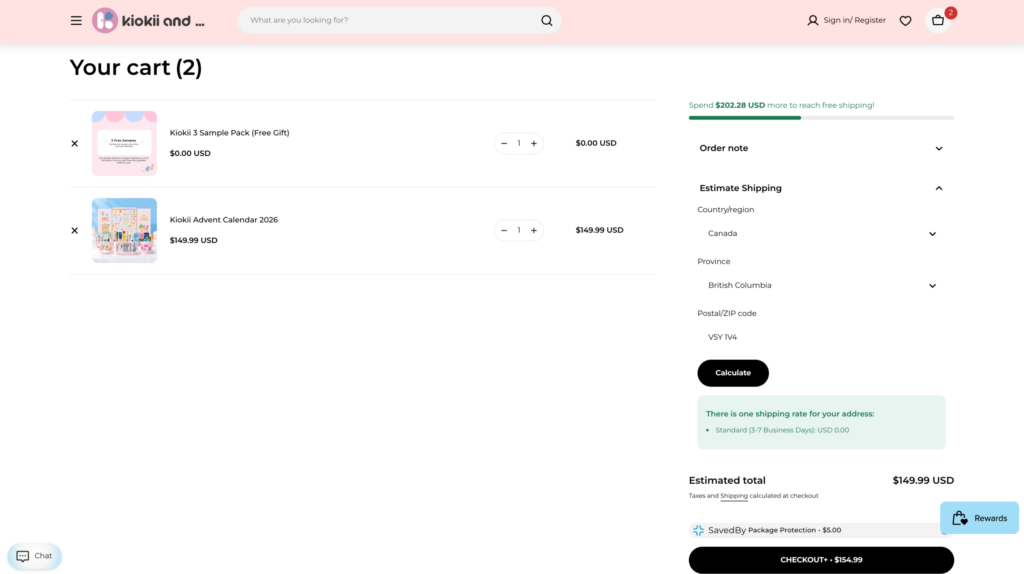
A well-designed cart page allows shoppers to review their selections, verify costs, and make final adjustments before proceeding to checkout. The example below from beauty retailer Kiokii and... illustrates how shipping estimates can be integrated directly into the cart, helping shoppers understand their expected order total before committing to checkout.
When evaluating cart page usability, four common sources of friction deserve particular attention:
- Unclear shipping costs and taxes: Shipping fees, taxes, or other charges are only revealed during checkout, making the final order total difficult to anticipate.
- Confusing discounts and promotions: Promotional thresholds aren't clearly explained, coupon codes are difficult to apply, or shoppers cannot tell whether offers can be combined.
- Limited product information and editing options: Shoppers cannot easily verify product variants, sizes, or availability, or modify their selections without returning to the product page.
- Poor mobile cart usability: Quantity selectors, remove buttons, and checkout CTAs are difficult to interact with, or the layout makes reviewing the order unnecessarily cumbersome.
Shipping Cost Transparency
Shipping costs can be the biggest blocker because they directly affect the shopper's assessment of the total purchase price. This is especially relevant for cross-border stores, where delivery fees can vary considerably by destination.
According to Baymard, 64% of users look for shipping costs before adding products to their cart. When these costs remain unclear until checkout, shoppers may need to advance further into the purchase process simply to determine whether the order is worthwhile.
Kiokii and... addresses this through an Estimate Shipping feature on its cart page. Shoppers can select their country or region, state or province, and postal code to calculate expected delivery charges without entering checkout. The cart also indicates how much more they need to spend to qualify for free shipping, connecting cost transparency with an opportunity to increase AOV.
Not every store needs a dedicated shipping calculator. Depending on the shipping model, a fixed delivery fee, destination-based estimate, or clear free shipping policy may be sufficient. The objective is to provide meaningful cost information early enough for shoppers to make an informed purchase decision.
shipping number early. Before clicking Checkout, it removes much of the uncertainty around the final order total.
3. Four Ways to Increase Average Order Value
Once shoppers have reviewed their cart, there may still be opportunities to increase the value of their order. The challenge is to make these opportunities relevant and convenient, without adding unnecessary decisions or competing with the primary checkout action.
There are 4 main strategies to encourage larger purchases:
- Relevant cross-selling recommendations: Suggest complementary products based on what's already in the cart. For example, a shopper purchasing a coffee machine might benefit from compatible filters, coffee beans, or cleaning supplies. Recommendations should be selective, easy to add, and positioned without obstructing checkout.
- Free shipping and promotional progress indicators: Show shoppers how close they are to qualifying for a reward. Instead of a generic "Free shipping over $50" message, a dynamic indicator such as "You're $8 away from free shipping" makes the incentive more tangible.
- Clear bundle and add-on savings: Highlight the financial benefit of purchasing related products together. Showing the original combined price alongside the discounted bundle price helps shoppers assess whether the offer provides meaningful value.
- Convenient product upgrades: Allow shoppers to switch to a larger size, higher specification, or premium version without restarting the product selection process. An option such as "Upgrade to Pro for $20 more" can encourage upselling while keeping the original purchase straightforward.
The Free Shipping Progress Indicator
Free shipping thresholds are a particularly interesting example because they connect the customer's perceived value with the retailer's objective of increasing order size.
Research by Kivetz, Urminsky, and Zheng, published in the Journal of Marketing Research, describes the goal-gradient effect, where people tend to accelerate their efforts as they perceive themselves getting closer to a reward.
For eCommerce, a cart progress indicator applies a similar principle by showing shoppers how close their current order is to a free shipping or promotional threshold.
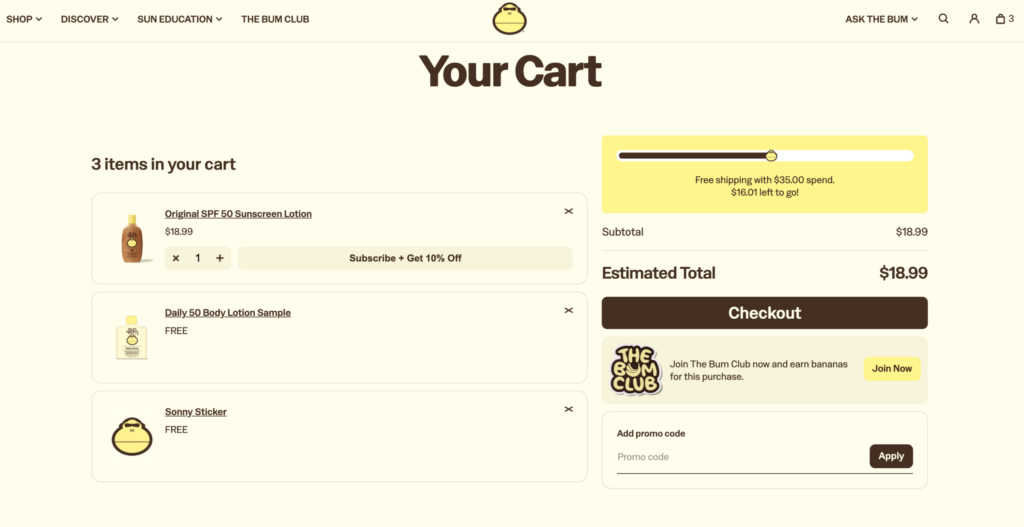
In the example above, Sun Bum uses a progress bar in its cart to communicate the remaining spend required to qualify for free shipping. The incentive is visible while shoppers review their order, without requiring them to navigate to a separate promotional page.
However, the effectiveness of these incentives depends on the threshold and the products available to close the gap. If a shopper needs to spend considerably more than their current cart value, the reward may be less compelling. Relevant, low-cost add-ons can make the incentive more practical.
As with other cart page upselling techniques, the objective is to encourage additional spending without making the original purchase feel incomplete or unnecessarily expensive.
4. A/B Test: Can Cart Recommendations Improve Conversion Rate and AOV?
Product recommendations can introduce additional purchase opportunities without necessarily compromising checkout progression. One published A/B test illustrates how the placement and relevance of these suggestions can affect overall cart performance.
In an experiment reported by Shopify CRO agency Blend Commerce, session recordings revealed that shoppers were continuing to search for products after reaching the cart. The team tested a dynamic recommendation module positioned below the checkout buttons, allowing customers to discover additional products without interrupting their original purchase.
The variation reportedly improved all five measured outcomes:
| Metric | Reported improvement |
|---|---|
| eCommerce conversion rate | +7.46% |
| Average order value (AOV) | +10% |
| Cart completion rate | +39% |
| Total revenue | +43% |
| Average purchase revenue per user | +21.83% |
Although the published results do not include detailed sample sizes or statistical confidence intervals, the experiment offers a useful illustration of how cart recommendations can support both conversion and order value.
Importantly, the intervention was informed by observed shopper behavior rather than simply adding more promotional content to the cart. This reinforces the value of testing recommendations in context and evaluating their combined impact on conversion, AOV, and revenue before rolling them out more broadly.
5. How to Prioritize Cart Page Improvements
The examples above demonstrate that cart page optimization can influence both conversion rate and average order value. However, not every store will benefit equally from shipping calculators, product recommendations, or promotional incentives. The right improvements depend on where shoppers encounter friction and how they interact with the existing cart experience.
A useful starting point is to combine funnel analytics with behavioral data, such as session recordings, heatmaps, and usability observations. Together, these can help identify whether shoppers are struggling to proceed to checkout, reconsidering their purchases, or looking for additional products. For example:
- High cart abandonment or low cart-to-checkout rates: Investigate cost transparency, promotional rules, mobile usability, and whether the checkout CTA is sufficiently prominent.
- Strong cart-to-checkout progression but limited AOV growth: Evaluate opportunities for relevant cross-selling, product upgrades, bundles, or free shipping incentives.
- Significant differences across devices or markets: Examine whether mobile layouts, shipping policies, currencies, or regional purchasing expectations are affecting cart performance.
These observations should inform optimization hypotheses rather than be treated as definitive explanations. A/B testing can then help determine whether proposed changes improve the overall purchasing experience and commercial outcomes.
Ultimately, cart page optimization should be measured by its contribution to completed orders and revenue, rather than isolated increases in engagement with recommendations or promotional elements.
At TMO Group, we help brands improve eCommerce performance through a combination of UX analysis, experimentation, and AI-driven commerce features like product recommendation engines. Reach out to us to discuss opportunities to improve your store's conversion performance.
FAQ
Cart page optimization focuses on helping shoppers review their orders, resolve uncertainties, and potentially add more products before checkout. Checkout optimization focuses on completing the transaction efficiently, including address entry, delivery options, payment methods, and order confirmation.
Common issues include unexpected shipping costs, unclear discount rules, difficult-to-edit product selections, and poor mobile usability. These can create uncertainty or unnecessary effort before checkout, particularly for cross-border eCommerce stores where shipping fees and delivery conditions vary by market.
Cart pages can encourage larger orders through relevant cross-selling recommendations, product upgrades, discounted bundles, and free shipping incentives. These features work best when they complement the shopper's original purchase rather than interrupting the path to checkout.
Not necessarily. Relevant recommendations can help shoppers discover complementary products without leaving the cart. However, excessive suggestions or intrusive placements may introduce distractions. A/B testing can help determine whether recommendations improve AOV without negatively affecting conversion.
Free shipping progress bars can encourage shoppers to add products by showing how close they are to qualifying for free delivery. Their effectiveness depends on the spending threshold, shipping costs, and availability of relevant add-ons. Brands should test whether the incentive improves overall revenue and profitability, rather than AOV alone.
Key metrics include cart-to-checkout rate, cart abandonment rate, checkout completion rate, average order value (AOV), and revenue per cart session. Evaluating these together helps determine whether changes increase overall revenue instead of simply encouraging larger orders among fewer customers.