



How can your store move beyond handpicked “Related Products” and deliver a product experience that feels relevant to every shopper?
AI product recommendation systems help eCommerce brands turn browsing, search, cart, and purchase data into more relevant product suggestions. When implemented well, personalization engines can lift conversion rates by 10% to 15%, while also improving average order value and product discovery.
In this article, we break down the main types of AI product recommendations, where to deploy them across the customer journey, what to consider if your store is on Magento or Shopify, and the common implementation mistakes that prevent recommendation systems from driving real revenue.
TMO Group helps D2C brands implement practical AI solutions for eCommerce, including product recommendation systems, intelligent search, data infrastructure, and platform integration.
How do AI Recommendation Systems Work?
An AI product recommendation system analyzes shopper behavior and product data to surface the most relevant items for each visitor. Instead of relying on manually selected “Related Products,” it uses signals such as browsing history, search queries, cart activity, purchases, product attributes, and customer segments to decide what to show, where to show it, and when.
As more interaction data accumulates, the system can improve its recommendations over time. In practice, it works like a sales associate: identifying shopper intent, matching it with the right products, and helping customers discover items they are more likely to consider or buy.
4 Types of AI Product Recommendations
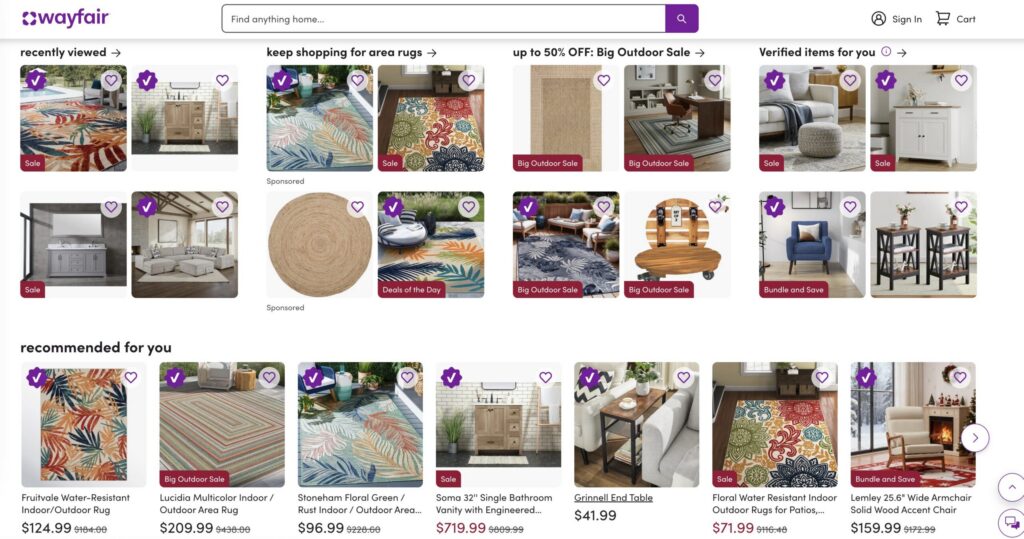
AI recommendation systems can draw from several types of data, including:
- Patterns across similar shoppers
- Product attributes such as category, brand, price, color, size, or specifications
- Current-session behavior, including browsing path, search terms, cart activity, and time on page
- Contextual signals such as device type, traffic source, location, and time of day
The strongest recommendation systems rarely depend on one signal alone, instead combining multiple angles to understand shopper intent, match it with relevant products, and adapt as more data becomes available:
| Type | Logic | Data Requirements | Best Fit |
|---|---|---|---|
| Collaborative Filtering | Similar user behavior | High | Established stores |
| Content-Based | Product attribute similarity | Low | Early-stage / fast-growing SKUs |
| Real-Time Contextual | Current session signals | Low | Any stage |
| Hybrid | Combination | Medium to High | Growth to mature stage |
Shopping Assistants can also be a great medium to serve product recommendations. We wrote about this in detail in a separate article:

1. Collaborative Filtering
Collaborative filtering recommends products by comparing one shopper’s behavior with the behavior of similar shoppers. This is the logic behind familiar modules such as “Customers who bought this also bought.”
- Its main advantage is that it can uncover product relationships that are not obvious from catalog data alone. For example, two products may belong to different categories but frequently appear in the same purchase journey.
- The limitation is that collaborative filtering needs enough user behavior data to work well. For newer stores, new markets, or recently launched SKUs, the signal may be too thin to produce useful recommendations.
2. Content-Based Recommendations
Content-based recommendations use product attributes to suggest similar items. These attributes can include category, brand, color, size, material, specifications, price range, use case, or style.
- This approach is useful when behavioral data is limited. For example, a newly listed product can still be recommended if its attributes are structured properly, making content-based logic especially relevant for brands with frequently updated catalogs, seasonal launches, or large SKU ranges.
- The weakness is that it can become too narrow if the system only shows products that look almost identical to what the shopper has already viewed.
3. Real-Time Contextual Recommendations
Real-time contextual recommendations respond to what a shopper is doing in the current session. Signals may include browsing path, time on page, search terms, device type, traffic source, location, and time of day.
This logic is particularly useful because intent can change quickly. For example, a shopper browsing from a mobile ad may need different recommendations from a returning customer comparing products on desktop. Contextual recommendations help the system adapt in the moment instead of relying only on historical behavior.
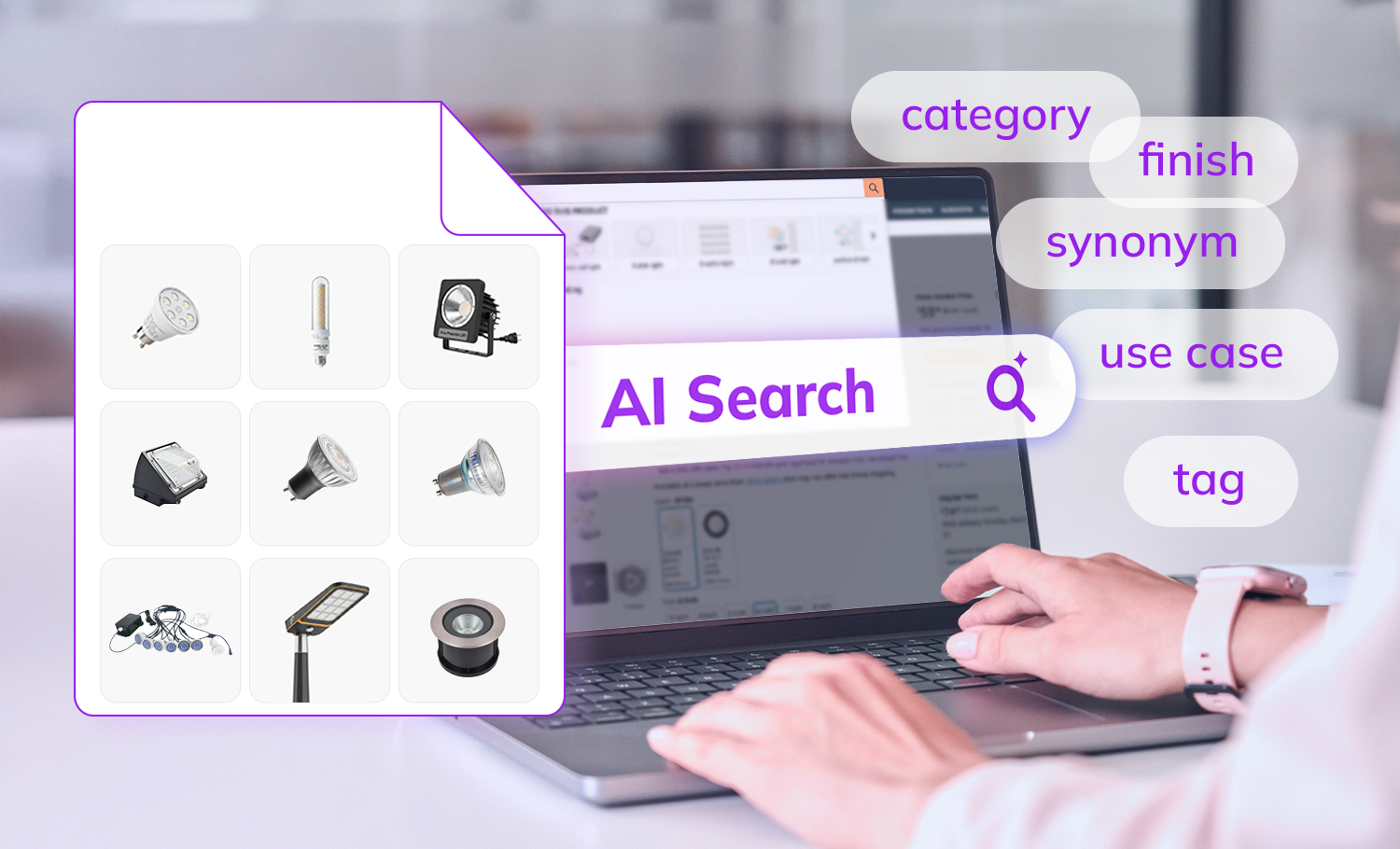
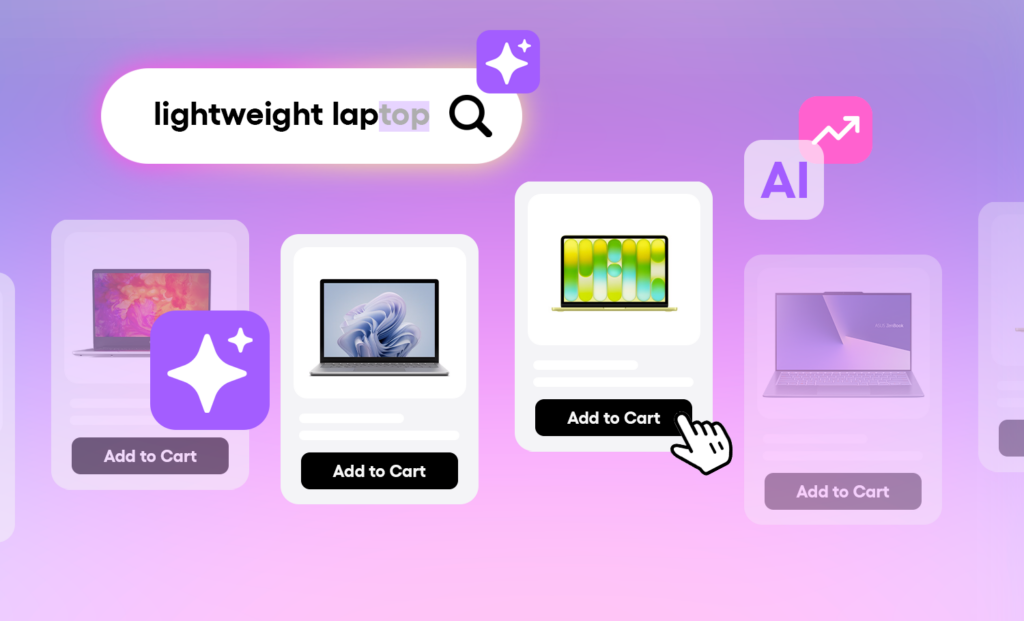
Intelligent search bars are one great example of real-time contextual recommendations:
4. Hybrid Recommendations
Hybrid recommendation systems combine collaborative filtering with content-based logic. Instead of relying on one signal, they adjust the recommendation model based on the available data:
- For a first-time visitor, the system may lean more heavily on product attributes, location, device, or current browsing behavior.
- For a returning customer with a purchase history, it can give more weight to behavioral patterns and similar-customer data.
This is usually the most practical model for mature eCommerce brands because it balances personalization depth with coverage across new users and new products.
Where to Deploy AI Recommendations
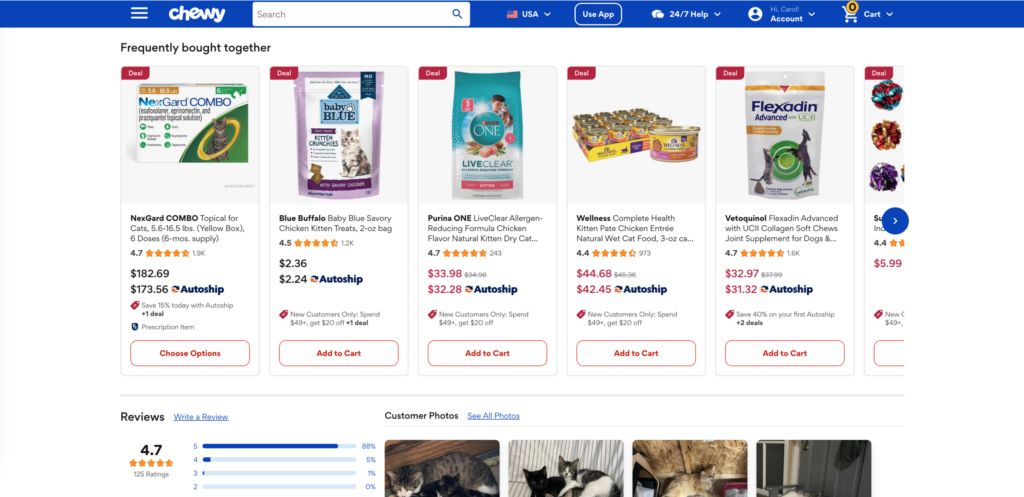
AI recommendations usually create the most measurable impact when they are placed close to purchase intent or embedded into lifecycle moments where the brand already has useful customer context. For most projects, the strongest starting points are product detail pages, cart, and post-purchase flows:
a) Product Detail Pages
Product detail pages are where purchase intent is usually strongest. The shopper is already evaluating a specific item, which makes this a natural point to introduce relevant alternatives, complementary products, bundles, or “frequently bought together” suggestions.
"The goal is not to distract the shopper from the product they came to view, so a good recommendation module should support the decision by helping them compare, complete the purchase, or discover a better-fit option."
For example, a pet care retailer can recommend products commonly purchased by customers with similar pets, needs, or purchase histories. A beauty brand can surface products from the same routine, such as cleanser, serum, moisturizer, and sunscreen. A furniture brand can recommend pieces that match the same style, material, or room setup.
b) Shopping Cart Pages
The cart is one of the last points where a brand can influence order value before checkout. Recommendation logic here should be more selective than on product pages because the shopper has already made a purchase decision.
"The strongest cart recommendations usually focus on complementary products, bundles, refills, accessories, or higher-value alternatives that make sense with what is already in the cart. This is where cross-sell and upsell logic can directly support average order value."
For example, Gymshark’s cart-level “Add a little extra” module expands the shopper’s consideration from a single item to a broader training outfit. The same logic can apply to skincare routines, pet supplies, electronics accessories, homeware sets, or B2B reorder packs.
But be careful about overloading the cart with irrelevant suggestions: at this stage, recommendations should feel useful and easy to act on, not like a last-minute interruption before checkout.
c) Post-Purchase and CRM Flows
Recommendations should not stop once the order is complete. After purchase, brands can apply recommendation logic across thank-you pages, order confirmation emails, replenishment reminders, win-back campaigns, loyalty flows, and other CRM-driven touchpoints.
"At this stage, the goal will not always be immediate conversion but about extending the customer relationship. Useful recommendation angles include consumable replenishment, compatible accessories, product-care items, refills, upgrades, or category discovery based on the customer’s purchase history."
For example, a skincare brand can recommend a refill before the expected usage cycle ends. A pet care brand can trigger food or supplement reminders based on pet profile data. A fashion brand can follow up after delivery with styling suggestions or complementary items. A B2B seller can remind buyers to reorder frequently purchased consumables or suggest related SKUs based on previous purchasing patterns.
The key is timing. Post-purchase recommendations work best when they are tied to actual customer context, not generic “you may also like” logic. CRM data, purchase intervals, product lifecycle, customer segments, and engagement history should guide what gets recommended and when.
Implementing AI-driven Recommendations: Shopify & Magento
Shopify and Magento both offer several ways to implement AI product recommendations. Shopify brands can often start with apps such as Rebuy, LimeSpot, Wiser, Glood, or Aqurate. Adobe Commerce brands may use Adobe Product Recommendations or third-party Magento extensions, while more complex stores may require enterprise personalization platforms or custom recommendation logic.
Keep in mind that while these tools enable personalization, recommendation quality will ultimately depend on the data and logic behind it:
Incomplete product attributes, inconsistent categories, weak event tracking, fragmented customer data, and unclean purchase history will all limit recommendation performance, regardless of how advanced the engine is.
The same applies to business rules: a recommendation system that ignores margin, inventory, promotions, customer segments, or product lifecycle can easily recommend the wrong products for the business, even if the algorithm is technically working.
Before choosing a tool, check whether you have:
- Clean product attributes and category structure
- Reliable browsing, search, cart, and purchase tracking
- Connected customer and CRM data where relevant
- Clear rules for margin, stock, promotions, and exclusions
- A plan for A/B testing and ongoing optimization
Common Mistakes in AI Recommendation Projects
- Cold-start problems: New stores, new markets, and newly launched products often lack enough behavioral data for strong recommendations. In these cases, product attributes, category logic, and guided preference data are more reliable starting points.
- Fragmented data across systems: Recommendation quality drops when product data, customer data, CRM records, email data, advertising data, and purchase history sit in separate systems. Cross-system data integration is often a prerequisite for stronger personalization.
- Overly narrow recommendations: If the system only recommends products that are too similar to what the shopper already viewed, recommendations can become repetitive. Effective recommendation logic needs to balance relevance with discovery.
- Algorithmic output disconnected from business goals: A recommendation engine may technically work but still recommend low-margin products, out-of-stock SKUs, products under promotion conflict, or items the merchandising team does not want to prioritize. Business rules need to guide the algorithm.
- No ongoing optimization after launch: Recommendation systems should not be deployed and left alone. Teams need to monitor CTR, add-to-cart rate, attributed revenue, AOV change, conversion lift, and repeat purchase behavior, then adjust placements, logic, and rules over time.
TMO helps Magento and Shopify brands assess recommendation readiness, implement AI recommendation tools, connect product and customer data, define business rules, and develop custom recommendation logic when standard apps cannot support the required level of control.
How to Start Without Overbuilding
For most D2C brands, the right starting point is to validate the recommendation logic, measure commercial impact, and only then expand into deeper personalization. Start with the basics:
- Audit your data foundation: Check whether browsing, search, cart, purchase, product attribute, and CRM data are being captured cleanly enough to support personalization.
- Begin with high-intent touchpoints: Product detail pages and cart pages are usually the best first tests because shopper intent is already clear and performance is easier to measure.
- Use platform-native or proven third-party tools first: Shopify and Magento/Adobe Commerce tools can help validate recommendation logic before the brand commits to deeper customization.
- Define the business rules early: Decide how recommendations should account for margin, inventory, promotions, exclusions, bundles, new arrivals, and customer segments.
- Measure beyond clicks: Track recommendation CTR, add-to-cart rate, attributed revenue, AOV change, conversion lift, and repeat purchase behavior for post-purchase flows.
Once the basics are working, recommendations can be connected with broader AI eCommerce use cases such as intelligent search, CRM automation, customer service workflows, and dynamic pricing. That is where AI starts to move beyond isolated widgets and becomes part of the wider commercial system.
Building AI-Driven Commerce Experiences with TMO
AI product recommendations are only one part of a broader commerce strategy. Their effectiveness depends on the same foundations that support other AI use cases: clean product data, reliable customer signals, connected systems, and clear rules around margin, inventory, merchandising, and customer experience.
For D2C brands, the opportunity extends beyond recommendation modules. AI can support front-end experiences such as product discovery, intelligent search, guided selling, personalization, and customer service, as well as operational workflows such as content generation, catalog enrichment, CRM segmentation, reporting, and process automation.
TMO helps with AI implementation across the commerce stack. We work with eCommerce teams to assess data readiness, identify high-value use cases, plan the right technical approach, and integrate AI capabilities into existing platforms and workflows.
If you are assessing where AI could create value for your eCommerce business, get in touch with us to define the right use cases and a realistic path to deployment.
FAQ
AI recommendations are best suited to brands with meaningful traffic and SKU volume, since data is the fuel they run on. For mid-to-large D2C brands hitting a growth plateau, a well-configured recommendation system is usually one of the highest-ROI AI investments available.
Most mature brands benefit from a hybrid model. The right starting point depends on your data volume and catalog complexity. If you have significant behavioral data, prioritize systems capable of continuous learning. If your catalog updates frequently, make sure your chosen approach handles new products without a cold-start delay.
Product detail pages, cart pages, and post-purchase pages consistently outperform homepage placements in terms of measurable conversion impact. These are the placements where purchase intent is clearest and ROI is easiest to attribute.
Apps are a good starting point for validation, but they tend to hit limits as data volume and operational complexity grow. Multi-market operations and margin-sensitive merchandising typically require deeper customization and system-level integration that off-the-shelf plugins cannot support.
The most frequent root causes are fragmented data, cold-start challenges, and misalignment between algorithmic outputs and business goals. Over-reliance on tools without a supporting strategy typically produces recommendations that look smart on the surface but contribute little to revenue.
Since recommendation quality is a direct function of input data quality, a health assessment before deployment prevents tool investment from being eroded by poor data. TMO can help you evaluate your current data readiness before committing to a full build and define a data governance framework.